
In the coming weeks, the ZMAI team, within the framework of the *Monitoring of Possible Abuse of State Resources* project—supported by the National Democratic Institute (NDI) and funded by the National Endowment for Democracy (NED)—will present findings and brief reports from the initiative *“The Use of State Resources During Election Processes.”* The first published analysis will focus on the impact of elections on employment in the public sector, including consulting and other contractual services. The analysis is based on publicly available data on realised budget transactions from open.finance.gov.mk covering the period 2010 to 2023 (excluding data from public healthcare institutions and the Health Insurance Fund, which are not publicly available), as well as data on the number of regular employees from the Ministry of Information Society and Administration (MISA) for the period 2015 to 2023.
“Election processes affect the dynamics of temporary employment and consulting services in the public sector, but periods of government change have the strongest impact.”
One of the key findings confirms public expectations regarding employment trends. While election processes do have an effect on both temporary and regular employment, the impact is more pronounced during periods of government transition. Notably, at the beginning of a new government’s term, there is often a spike in temporary employment and consulting contracts. Over time, these engagements tend to decrease—likely due to the conversion of temporary contracts into permanent positions.
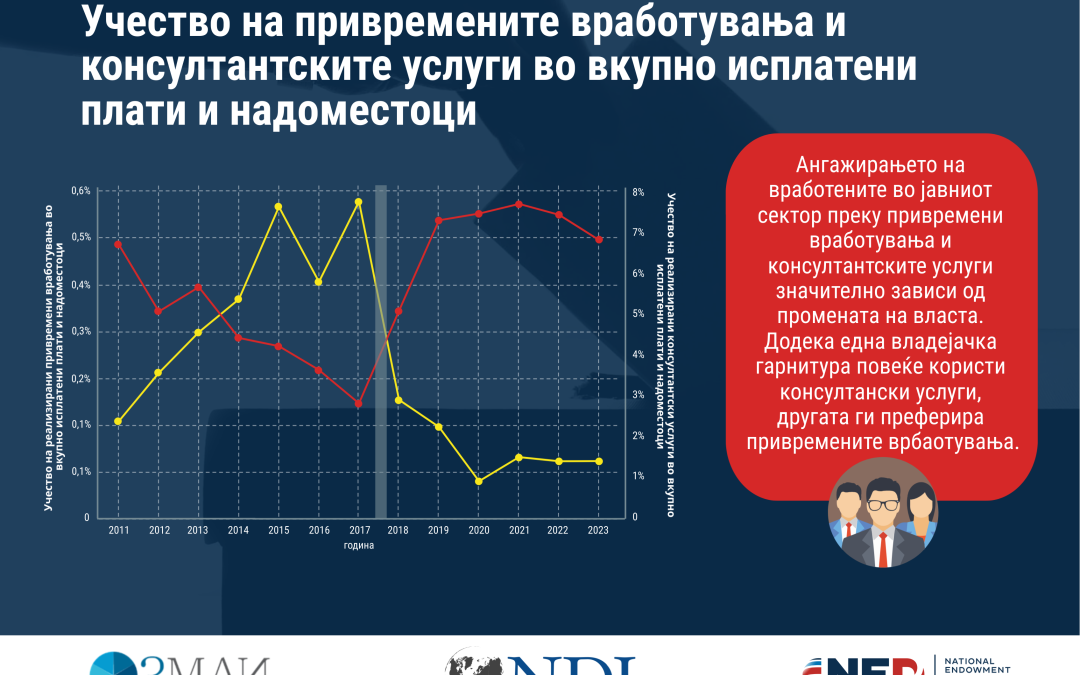
Temporary Employment and Consulting Services in Central Government
Shifts in temporary employment and consulting services are evident following changes in government. While some administrations favoured consulting contracts, others relied more heavily on temporary employment. Following a change in government, there is typically a spike in temporary employment payments, which then gradually decline—presumably as more individuals transition to regular employment status.

Regular Employment
Trends in regular employment provide additional insight. Although there are no significant peaks directly tied to election years, changes become evident in the period following elections. For instance, after the 2017 government transition, there was a noticeable increase in regular public sector employment in 2018–2019. A similar trend occurred in 2021, following the 2020 elections. These patterns suggest that new administrations often require several months to a year to fully leverage public sector employment opportunities. However, in recent years, public administration jobs appear to have become less attractive, with overall employee numbers returning to 2015 levels.

Key Findings from the Analysis
The dynamics of temporary and regular employment vary significantly depending on political changes and election cycle
- At the central level, the highest payment for temporary employment was recorded in 2010, when the amount was five times higher than the next highest level in 2023. In 2011, payments dropped by 89%, likely due to conversion to regular employment, a change in engagement method (e.g. contracts for services or authorship contracts), or termination of employment.
- A major relative change occurred in 2018, with an 80% increase compared to the previous year—attributed to additional hiring and an increase in the minimum wage.
- In 2011, 2014, and 2016—years when parliamentary elections were held—payments for temporary employment decreased by 26%, 20%, and 9%, respectively. This trend did not continue in 2020, when an increase of 10% was recorded.
- At the local level, payments for temporary employment show an increasing trend, caused by newly temporarily employed persons and by an increase in the minimum wage.
- The largest changes occur in 2011, 2016, 2018 and 2023.
In 2011, a decrease in payments of 30% was observed compared to the previous year, which—similarly to the central government—was likely caused by the same factors. In 2016, an increase of 16% was recorded, most likely due to a rise in the number of temporary employees. In 2018, a 34% increase was observed, attributed to an increase in the minimum wage and additional temporary employment. In 2023, payments increased by 22%, again due to the rise in the minimum wage.
- In temporary employment at the local level, it is noted that payments increase after the elections and that, except in 2010, there is a general trend of increase.
Payments for regular employees in the public sector have shown a decreasing trend, despite increases in wages.
- The share of wages and benefits in the total realised budget has declined over the years but has been on an upward trajectory since 2021, coinciding with a period of significant wage increases in the public sector.
- The share of public sector employees relative to the total working population increased between 2017 and 2022.
Consulting services display trends linked to election cycles at the central level, while at the local level they remain relatively stable.
- At the central level, consulting services peaked in 2015 and 2017. These increases in payments occurred after election periods, suggesting either delayed payments or the hiring of consultants post-election.
The Association for Research and Analysis ZMAI, within the framework of the Monitoring Possible Abuse of State Resources project—supported by NDI and funded by the National Endowment for Democracy (NED)—will publish the full initial overview of its analysis on public sector employment next week. A detailed media briefing is also planned to help journalists better understand and interpret publicly available data.
In the period ahead, the formation of a new government cabinet and changes in the executive branch are expected.
We welcome the statements of the new parliamentary majority indicating a commitment to further enhancing transparency and accountability in the financial operations of public institutions.
Recent Comments