
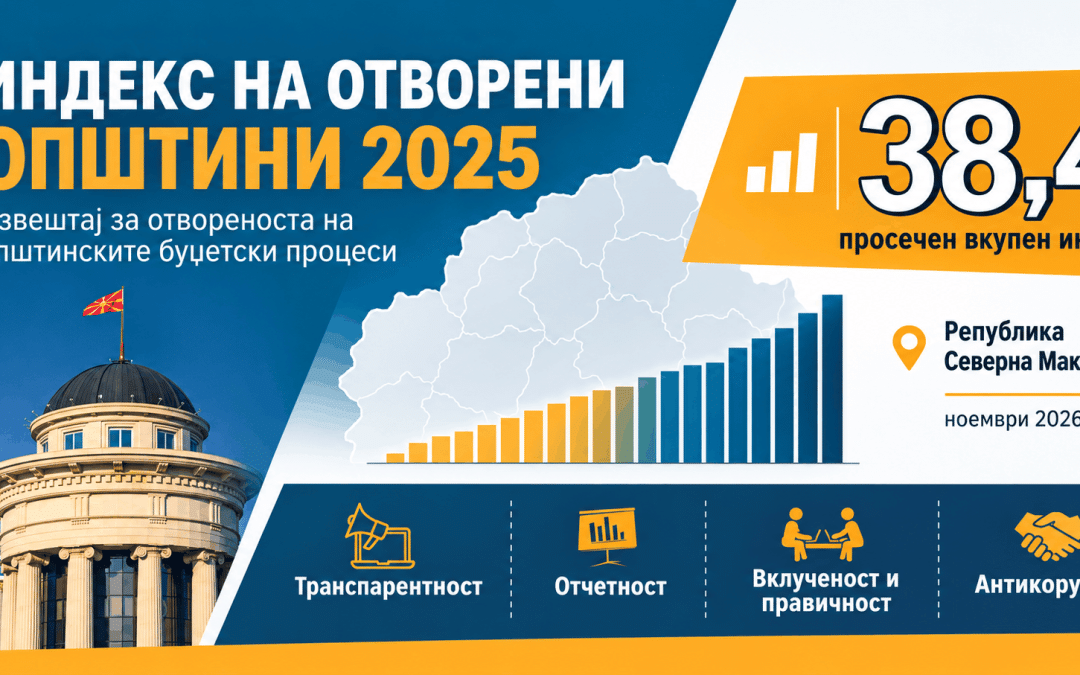
How open are municipalities to citizens when making decisions about spending public funds? To what extent do they consider citizens’ needs and priorities, and how accountable are they in managing municipal budgets? Although local government is the level of government closest to citizens, transparency, public participation in decision-making, and oversight of public spending remain significant challenges. The latest Open Municipalities Index for the 2025 fiscal year, published by the Association for Research and Analysis ZMAI for the sixth consecutive year, reveals substantial disparities among municipalities, as well as systemic weaknesses in how local authorities plan, spend, and disclose information about public funds.
The average score across 81 local government units stands at 38.4 out of a possible 100 points, with 47 municipalities falling into the categories of minimal or insufficient openness. Kriva Palanka once again tops the ranking with 86.4 points and is the only municipality to achieve comprehensive openness in its budget processes, earning ZMAI’s Certificate of Comprehensive Budget Openness.
On this occasion, the Certificate of Comprehensive Budget Openness for 2025 was presented today to the Mayor of Kriva Palanka, Sashko Mitovski. During the award ceremony, ZMAI Executive Director Viktor Mitevski emphasized that, after six years of monitoring, the organization had expected more municipalities to meet the criteria for comprehensive openness. He highlighted the municipality’s particularly strong performance, achieving 100 out of 100 points in inclusion and equity and 98 out of 100 points in transparency.

The Mayor expressed his gratitude for the recognition awarded to the municipality, emphasizing that the achievement was the result of teamwork and the collective efforts of municipal employees. “For us, it is important that citizens are involved in budget decision-making,” he stated, also thanking citizens for their active participation in municipal processes.
Citizen participation remains the most significant democratic deficit. The “Inclusion and Equity” dimension received an average score of just 23.4 points. This highlights the limited opportunities available to citizens, including marginalized groups, to propose budget priorities and receive information on whether and how their suggestions have been considered.
Access to essential financial information also remains a serious concern. Only 29 municipalities published a citizens’ budget, a document designed to explain where municipal revenues come from and how expenditures are planned. A total of 61 municipalities published their year-end budget accounts, which allow the public to monitor budget implementation. In 87.7% of municipalities, budgets are not available in an open, machine-readable format, making comparisons and independent public oversight more difficult.
Public procurement practices provide further evidence of the need for stronger oversight. A total of 27 municipalities did not publish their public procurement contracts, while 26 failed to publish their annual public procurement plans. In 27 municipalities, at least 36% of procurement procedures received only a single bid. Such procedures indicate limited competition and highlight the need for better procurement planning and monitoring, although they do not, in themselves, constitute evidence of unlawful conduct.
A comparison with the previous year presents a mixed picture. The share of municipalities publishing a citizens’ budget declined from approximately 42% in 2024 to 35.8% in 2025. The number of municipalities publishing year-end budget accounts decreased from 63 to 61, while the number of municipalities without a published annual public procurement plan increased from 23 to 26. Inclusion and equity improved from 20.4 to 23.4 points but remained by far the lowest-scoring dimension.
“Citizens should be able to see where municipal money goes, influence spending priorities, and verify what has actually been implemented. When 52 municipalities fail to publish a citizens’ budget and one in three does not publish public procurement contracts, public oversight is severely limited. Budget openness must become a standard practice for every local authority, regardless of political developments and changes in government,” stated Viktor Mitevski, Executive Director of ZMAI.

ZMAI calls on municipalities to publish their budgets, year-end accounts, and public procurement documentation in a timely manner and in open formats; establish clear mechanisms for citizens to submit proposals and receive feedback; and introduce measures to strengthen competition in public procurement.
The Open Municipalities Index assesses transparency, accountability, inclusion and equity, and anti-corruption practices, with the aim of translating its findings into concrete improvements in local governance.
The full report is available at the following link, while individual municipality results can be accessed here.
The underlying data from the Open Municipalities Index assessment are available in Excel format.
Recent Comments